
A client sends over a 90-second explainer script and asks what it costs to animate. You quote $9,000. They come back with a Fiverr offer for $400. Now you are defending your number instead of building the video.
Motion graphics cost swings harder than almost any other line item in video production. The phrase covers a five-second logo sting and a photoreal 3D teardown of a surgical device equally well. Two orders of magnitude, same two words. What follows is the 2026 range for each type of work. Then the math behind those numbers, and the decisions that move a quote before anyone opens After Effects.
Why motion graphics cost is quoted per finished second
Live action hands you footage in real time. Point a camera at a room for an hour and you get an hour of material. Most of it is unusable, but all of it arrived at 1x. Animation has no 1x. Every frame gets constructed by hand, so the only sane unit of measure is hours of labor per finished second.
Here is the ratio most working animators quote from. It holds up across every studio I have subcontracted to:
- Kinetic typography and simple shape animation: 1 to 3 hours per finished second
- Illustrated 2D with rigged characters and backgrounds: 3 to 8 hours per finished second
- Photoreal 3D with modeling, lookdev, and simulation: 8 to 25 hours per finished second
Multiply by an hourly rate and the pricing stops feeling arbitrary. A 60-second illustrated explainer at 5 hours per second is 300 hours of labor. At a freelance rate of $85 an hour, that is $25,500 of raw time. Which is why almost nobody builds a fully bespoke 60-second explainer at the low end of the market. They reuse rigs, buy character libraries, flatten the style, and cut the ratio in half. That reuse is legitimate craft, not cheating. It is also the single biggest reason two honest quotes differ by 4x.
When an animator hands you a flat project fee, they have done this arithmetic in their head. Then padded it for revisions and buried it behind one number. Ask what animation ratio they assumed. A good one answers without flinching. If the answer is vague, the number is a guess, and guesses get revised upward in week three.
What motion graphics cost in 2026: the working ranges
US and UK rates as of early 2026, for work that clears a client review without embarrassment:
- Text on screen, lower thirds, data callouts: $20 to $60 per finished second
- Illustrated 2D explainer with custom art and rigged characters: $60 to $200 per finished second
- Photoreal 3D product animation: $150 to $600 per finished second
- Cloth, fluid, or particle simulation on top of 3D: add 30 to 50 percent
A 20-second animated stat sequence for a corporate deck lands around $600 to $1,200. A full 60-second illustrated piece, script and voiceover and sound design included, quotes between $4,500 and $14,000. Below $3,000 you are buying a template build with your logo dropped in. That is a fine purchase, as long as you know it.
3D is where the numbers get uncomfortable. Take a 15-second hero shot of a consumer electronics product, spinning apart into components and reassembling. A solo artist in Blender or Cinema 4D quotes $3,000 to $9,000. A studio with a lookdev supervisor and a render pipeline quotes $12,000 to $30,000. Most buyers do not need the studio version, and plenty buy it anyway.
Hourly rates sit underneath all of it. Freelance motion designers with a clean reel charge $65 to $125 an hour. Artists who can carry a 3D shot alone bill $125 to $200. Studios quote a blended $150 to $250 that covers a producer, an art director, and the animator.
Running an ongoing program rather than a one-off? Ask about a retainer. Monthly deals of $3,000 to $9,000 cover a set number of deliverables, and per asset that beats project-by-project buying. The catch is you have to feed it work. Half the retainers I watch clients sign go underused by month four.
Lower thirds, stings, and the small stuff that adds up
Most buyers do not need a 90-second explainer. They need a name tag under an interview subject. A logo animation at the head of the video. A call-to-action card at the end. That invisible majority is where motion graphics cost stops being a calculation and becomes a menu.
A custom logo sting, three to six seconds, runs $300 to $2,500. Flat 2D shape work sits at the bottom of that range, a 3D metal-and-light treatment at the top. A branded lower-third package costs $400 to $1,500, including a template file your editor can retype for every interview. A full brand kit with title cards, transitions, lower thirds, and an end card quotes $2,000 to $6,000. It pays for itself across a year of content.
Templates are the honest alternative, and I recommend them more often than clients expect. Envato Elements runs about $17 a month, Motion Array about $30, and both come with commercial licenses attached. A capable editor can retime and rebrand a whole template package in three or four hours. For internal training, YouTube uploads, and most event recaps, that is the right call.
Where templates fail is anything that has to feel specific to your brand. A licensed custom typeface, unusual logo proportions, a strict color system: the template will fight you. The result looks like a template wearing your colors. The tell is always the typography. Default tracking, the wrong weight, a kerning pair nobody fixed. Clients notice even when they cannot name what is wrong.
Why 3D quotes look so different from 2D
A 2D animator opens After Effects and starts making things move. A 3D artist has to build the world first. That pre-animation work is where the budget goes. The gap between 2D and 3D motion graphics cost is not markup, it is hours.
Modeling comes first. Supply a CAD file from your engineering team and you save $1,000 to $5,000 of modeling time. Someone still has to retopologize and clean it, because CAD geometry renders badly. Without CAD, the artist works from photos and dimensions. A moderately complex consumer product takes 15 to 40 hours.
Then materials and lighting, called lookdev. Photoreal work gets won or lost right here. Brushed aluminum, injection-molded plastic, and glass behave differently under the same light. Each takes iteration. Budget 10 to 25 hours for a product with four or five distinct materials. If a quote skips lookdev as a line item, the artist is leaning on presets.
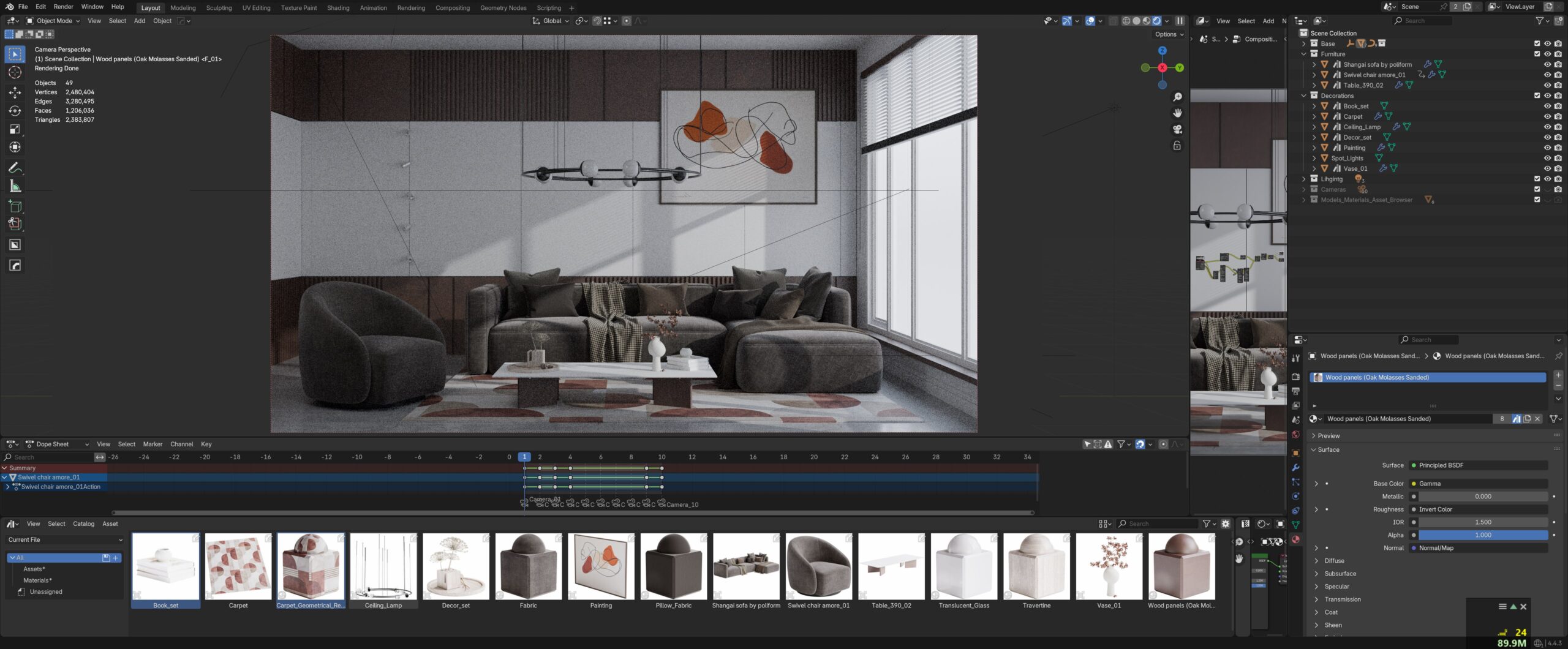
Rendering is a real line item, not a rounding error. Take a 15-second 4K shot at 24fps with global illumination. In Redshift or Cycles, that is four to twelve minutes per frame on a single RTX 4090. Across 360 frames you are looking at 24 to 72 hours of GPU time, and you will render it twice. Farms like GarageFarm and Fox Renderfarm turn that into a same-day result for $150 to $1,500.
Ask whether render fees sit inside your quote or get billed separately. A surprise $900 farm invoice in the final week is a common blowup on a first 3D project.
Blender has genuinely compressed the low end of this market. An artist with Blender and a good GPU produces work that needed a $15,000 stack in 2018. Cinema 4D still runs around $1,000 a year. That is why solo artists now compete with small studios. Judge on the reel, not the tool list.
What actually moves your quote up or down
Six variables, roughly in order of impact. The first is where most budgets get saved or lost, and it is the one buyers try to skip.
- Style frames. A designer produces two or three static frames showing exactly what the finished piece will look like. This costs $500 to $2,000 and it is the best money in the budget. Approving a still frame is cheap. Discovering you hate the art direction after 40 hours of animation is not.
- Revision structure. A good contract stages revisions: two at script, two at style frame, one at animatic, one at final. Changes at the final stage that force a return to storyboard get billed hourly, commonly $95 to $150. If a quote promises unlimited revisions, the price is padded or the animator has not been burned yet.
- Source files. Handing over the layered After Effects or Cinema 4D project adds 20 to 50 percent. Cleaning a working file into something another artist can open takes real hours, and you are buying a reusable asset.
- Voiceover and sound. A professional VO for a 60-second explainer runs $250 to $700 with unlimited web usage. Sound design and mix adds $300 to $1,200. Music through Artlist or Musicbed is $200 to $500 a year.
- Rush. Compressing a four-week schedule into ten days means overtime and reserved capacity. Expect 25 to 50 percent on top, and expect style frames to get squeezed. That is the wrong place to save time.
- Usage. Web and social are usually included. Paid media, broadcast, or a trade show loop running for three years carries a separate license, priced as a percentage of the fee.
Of those six, only rush and usage sit outside your control. The other four are decisions you make in the brief. The cheapest way to lower a motion graphics cost estimate is to write a sharper brief, not to negotiate the rate.

Freelancer, your videographer, or a studio?
A solo freelance motion designer is the right call for defined, self-contained pieces: a logo sting, a lower-third package, a 30-second social explainer, a set of data visualizations. You get the person doing the work, direct, at $65 to $125 an hour with no producer margin. The tradeoff is single-point risk. If they catch flu in week three, your deadline moves.
Your existing videographer often handles motion graphics in-house up to a point. For hybrid projects that is the cleanest arrangement going. Live-action footage with animated callouts, an interview cut with kinetic quote cards, a property walkthrough with an animated floor plan: one person owning the timeline saves a week of file handoffs. Plenty of corporate videographers keep a motion designer on call and fold the cost into a single quote.
Ask two questions before agreeing to that. Are the graphics built internally or subcontracted? Can you see graphics-heavy work from their own reel? Neither answer disqualifies anyone. A vague answer to both should.
Studios earn their premium on complex, multi-stakeholder work. A 3D pharmaceutical animation that has to survive regulatory review needs a producer whose entire job is stopping the process from collapsing. At $150 to $250 an hour blended, you are buying project management, art direction, and the ability to put three artists on one shot when the schedule slips.
Not sure which tier fits? Compare animation specialists against product video people and hold their reels up to the complexity of your piece. Then get three quotes on the same written brief. That tells you more about real market rate than any pricing article, this one included. Our video pricing overview covers how quotes get structured across the other categories.
If you are the videographer: pricing and subcontracting animation
Clients ask you what motion graphics cost before they ask almost anything else. Turn the work away and they find someone who will happily take the next shoot too. The practical move is to build a bench of two or three animators you trust and mark their work up.
Standard markup for subcontracted animation is 15 to 30 percent, and it is defensible. You are carrying the client relationship, the revision management, the payment risk, and the schedule. Do not present it as a pass-through cost with a fee bolted on. Quote a single project number. What the client buys from you is not access to an animator, it is not having to manage one.
Protect yourself on three fronts:
- Deposit. Bill enough up front to cover your subcontractor’s deposit, usually 50 percent, so you never fund someone else’s payroll.
- Revisions. Put a revision limit in both contracts, and make the client-facing one tighter than the animator-facing one, so a surprise round does not eat your margin.
- Source files. Settle ownership in writing at the start. Clients ask six months later, and if you never negotiated it, you have nothing to hand over.
Learning enough After Effects to handle lower thirds, simple masking, text animation, and basic tracking is roughly 40 hours of focused practice. That work is worth $400 to $1,500 a project and takes two to four hours once you are fluent. Full 3D is closer to a year before your reel is sellable, and it only pays off if you intend to specialize. If you want inbound work, showing animation samples when you join the videographer directory does more than adding the word to your bio.
How to brief an animator so the quote comes back accurate
Vague briefs produce padded quotes. Every animator who has been burned adds a margin for ambiguity, and you pay it whether or not the ambiguity shows up. A tight brief routinely takes 15 percent off a number.
Give the animator all of this in one message:
- A locked script with a word count. Roughly 150 words equals 60 seconds of voiceover, and runtime drives the whole quote.
- Your brand kit: fonts, hex codes, vector logo files, and any existing motion guidelines.
- Three reference videos you like, plus one you dislike with a sentence on why. The dislike is the more useful of the two.
- Who holds final approval. If it is a committee, say so, because that changes the revision estimate.
- Every deliverable and aspect ratio, including the 9:16 cutdown you will want later.
- The deadline as a real date, and whether it is fixed or aspirational.
- Whether you need source files. Retrofitting that request after delivery is expensive.
Before commissioning anything, price out the cheap version first. Buy a $30 template pack, spend an afternoon rebranding it, and see whether it clears your bar. If it does, you just saved four figures. If it does not, you now know exactly what is missing, and that description is worth more to an animator than any budget figure.
Motion graphics cost is less a number you look up than a number you shape. The brief, the style frames, and the revision clause decide it long before the first frame renders. Get those three right and the quotes coming back will be boring, accurate, and close to each other. If you are still mapping out the wider production, how the marketplace works walks through briefing and hiring end to end.