
Your venue deposit cleared, catering is signed, and roughly $7,500 is left for the two vendors who document the day. One quote sits open in a tab: $4,200 for eight hours of photography. The other says $3,900 for a two-person video team and a six-minute film. The wedding photographer vs videographer decision almost always lands right here, after the fixed costs have eaten the budget.
Most couples settle it on gut feel. That is the expensive part, because these are not two versions of the same job, and the thing that separates them is not artistic taste. It is sound.
The two roles look identical from a folding chair
From the back row, both vendors read the same: a person with a camera crouching near the aisle. The mechanics underneath are nothing alike. A photographer fires 2,500 to 4,000 frames across a wedding day and delivers 600 to 900 of them. On a Sony A1 or a Canon R5 in electronic shutter they work silently, take two steps, and try a different angle. A missed moment costs one frame out of thousands, and the next one is a quarter of a second away.
A videographer is chained to time and to audio. A usable shot runs six to ten seconds minimum. Bouncing around the room the way a photo shooter does produces footage no editor can cut together. Before the ceremony starts, the video team is taping a DJI Mic 2 transmitter inside the groom’s jacket. A Tascam DR-10L gets clamped to the officiant’s podium as a backup. A third line runs out of the DJ board for the speeches. Three sources for one set of vows, because the failure they fear is not a missed frame. It is forty minutes of ceremony with no usable audio.
The gear bills reflect all of that. A photographer covers a full day with two bodies and three primes, maybe $9,000 of kit. A two-person video crew arrives with a Sony FX3 and an FX30, plus a DJI RS 4 gimbal. Then two or three light sources, three audio recorders, and enough batteries to run ten hours without a wall outlet. Closer to $25,000 in gear, and it depreciates faster.
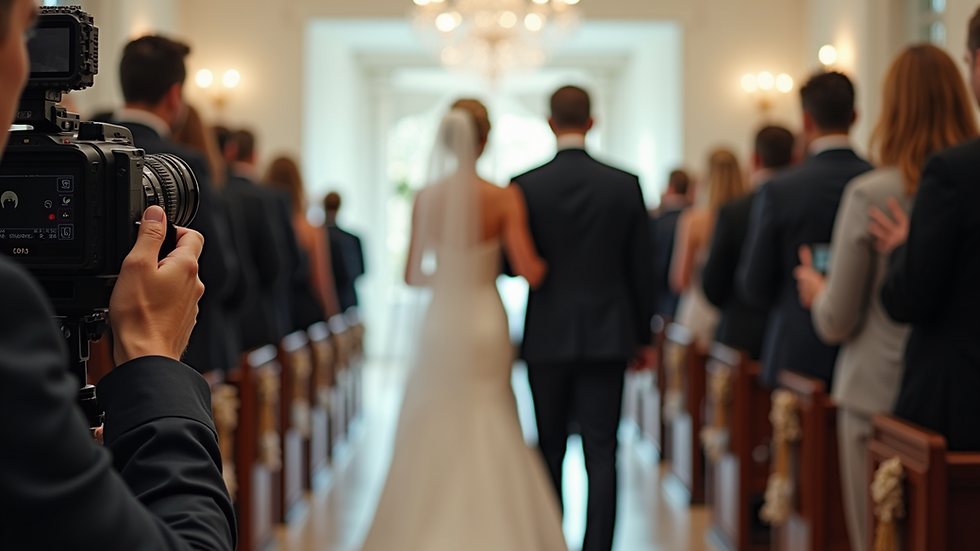
Crew size, edit hours, and price all flow downhill from that split. It also explains why the two vendors occasionally get in each other’s way. That is a real scheduling problem, not something to hope your way through.
What each vendor actually hands you
Photography delivery in 2026 is close to standardized. You get 500 to 900 edited high resolution JPEGs, delivered in a Pic-Time or Pixieset gallery with a print release. Turnaround is usually 4 to 8 weeks. Most shooters send a sneak peek set of about 30 images inside 72 hours. Albums are a separate line item, typically $900 to $2,500 for a 10×10 layflat. Those files are easy to share and easy to print. Three years later somebody will pull them up on a phone at a family dinner.
Video delivery arrives in layers. A standard 2026 package produces:
- A 4 to 8 minute highlight film cut to licensed music
- A full multi-camera ceremony edit, usually 20 to 45 minutes
- A separate speeches and toasts edit
- A 60 to 90 second vertical cut for social
Some studios also sell a 20 to 40 minute documentary edit that sits between the highlight and the raw ceremony. Turnaround runs longer than photography. Normal is 8 to 16 weeks. Twenty weeks is not unheard of if your date fell inside the September and October crush.
Then there is how each one actually gets used, which nobody prints in a brochure. Photos get opened often, maybe monthly through the first year. The film gets watched three or four times total. It lands harder every time. Nothing else holds your grandmother’s voice. Nothing else holds the crack in your partner’s speech, or the sound of the room when the doors opened. That is the entire argument for video, and no photographer can hand you any of it at any price.
Ask both vendors where your files live afterward. Twelve months of archiving is a common contract term. Plenty of studios purge at 90 days. Any studio promising to keep everything forever is describing marketing, not a plan. Download the gallery and the master files the week they land. Put a copy somewhere that is not your phone.
Wedding photographer vs videographer: 2026 price ranges
Mid-market wedding photography in a US metro runs $2,500 to $4,500 for eight hours with one shooter and an assistant. Established studios with a full calendar charge $5,000 to $9,000. A second-year shooter still building a portfolio will take $1,200 to $1,800, and some of them are excellent. True two-person coverage adds another $600 to $1,200.
Wedding video sits higher for equivalent hours. Budget $3,000 to $5,500 for a two-shooter team over eight hours with a highlight film and a full ceremony edit. Named studios in New York, Los Angeles, or Chicago run $6,000 to $12,000. A solo shooter working two locked cameras and a gimbal will quote $1,800 to $2,600.
Common add-ons, priced roughly:
- Drone coverage: $400 to $800, venue permitting
- Same-day edit screened at the reception: $1,500 to $3,000
- Raw footage delivery: $300 to $1,000
- Extra hour past contract: $250 to $500 for photo, $350 to $700 for a video crew
- A second audio source: free, from anyone competent
The price gap confuses people, so here is the mechanical reason. Eight hours of two-camera video generates 600GB to 1.5TB of footage. Cutting a six-minute highlight film out of that takes 25 to 40 hours. That means syncing angles, cleaning audio recorded next to a PA speaker, and grading log footage from three lighting situations. It also means licensing music that will not get the film muted on Instagram. Photo post is real work too, usually 15 to 25 hours of culling and editing, but it is shorter. You are paying for edit time you never see. Comparing the two by hourly rate misleads every couple who tries it.
Watch the line items that sit outside the package price. Travel beyond 50 miles runs roughly $0.70 per mile, or a flat $250 to $600. Hotel rooms land on you for destination dates, and some states tax creative services. The deposit is 30 to 50 percent and almost never refundable. Get the all-in number in writing before you compare anything. Gathering quotes is easier side by side, and browsing wedding videographers shows the real spread faster than any sales call. The pricing overview explains how those bands get set.
If the budget only covers one
Useful rules exist for the wedding photographer vs videographer split, and none of them are about which craft is more artistic.
Book photography first if:
- You want wall art, an album, and prints for a large extended family
- Your ceremony is short and civil
- The reception is the part you care about, and you want hundreds of candid frames of it
- Nobody is giving a speech you would want to hear again
Photos also survive neglect better. A gallery of JPEGs stays usable through every phone and laptop you will ever own. A 40GB video master needs somewhere to live and something to play it.
Book video first if:
- You wrote your own vows
- A grandparent or parent is giving a toast
- Anyone central to the day is in poor health
- You already know you will cry at the speeches
Every one of those is a sound-dependent moment. One vendor captures sound and the other does not, which makes this less of a taste question than couples expect.
There is a middle path most couples never think to ask about. Trim photography from ten hours to six, ending after the first dance, and spend the $600 to $900 you save on a ceremony-and-speeches video package. Plenty of videographers sell a four-hour documentary product at $1,200 to $2,000 with no highlight film: two locked cameras, three audio sources, a clean cut of the ceremony and the toasts. It is not cinematic and it does not need to be.
One warning, because a vendor will eventually pitch this to you. Frame grabs from video make a poor substitute for stills. A 4K frame is 8.3 megapixels, which sounds acceptable until you remember it was shot at a 1/50 second shutter for natural motion cadence. Anything moving carries blur that shows up immediately in a 16×20 print. Grabs are fine for a thank-you card. They are not a photography package.
One studio for both, or two separate vendors
Hybrid studios that sell photo and video together are everywhere, and the pitch is legitimate. One contract, one deposit, one timeline conversation. Add a bundle discount of $500 to $1,500 and two teams who have worked the same rooms a hundred times. Couples deep in the wedding photographer vs videographer decision often land here for exactly that reason. When it works, the coordination problem simply stops existing.
The risk is that most hybrid studios are excellent at one of the two and merely fine at the other. Check it the boring way. Ask to see the photo gallery and the film from the same wedding, not their best work from each department across different events. If they cannot produce a matched pair from one date, you have learned something worth knowing.
Ask who specifically is assigned to your date. Larger studios assign shooters two to six weeks out. The reel that sold you may have been shot by an associate who left the company last year. Get the named lead written into the contract, along with a substitution clause you can live with. That means a comparable replacement, a portfolio sent in advance, and a partial refund if you decline the swap.
Booking separately usually produces the better result. You pick the strongest option in each craft instead of accepting a package average. You pay for that in coordination work. Introduce the two vendors by email about four weeks out. Send both the identical timeline document, and let them settle positioning between themselves. Professionals appreciate the introduction. A vendor who gets cagey about working alongside another crew has told you something useful. Better to learn it before you sign. The how it works page covers the booking flow if you are hiring both sides through the directory.
How they share the day without stepping on each other
Conflicts between photo and video crews are predictable, which is what makes them preventable. The usual four:
- An on-camera flash pulsing through every reception clip
- An LED panel on a stand parked in the background of formal portraits
- Both teams claiming the center aisle for the recessional
- A photographer’s assistant standing exactly where the wide shot lives
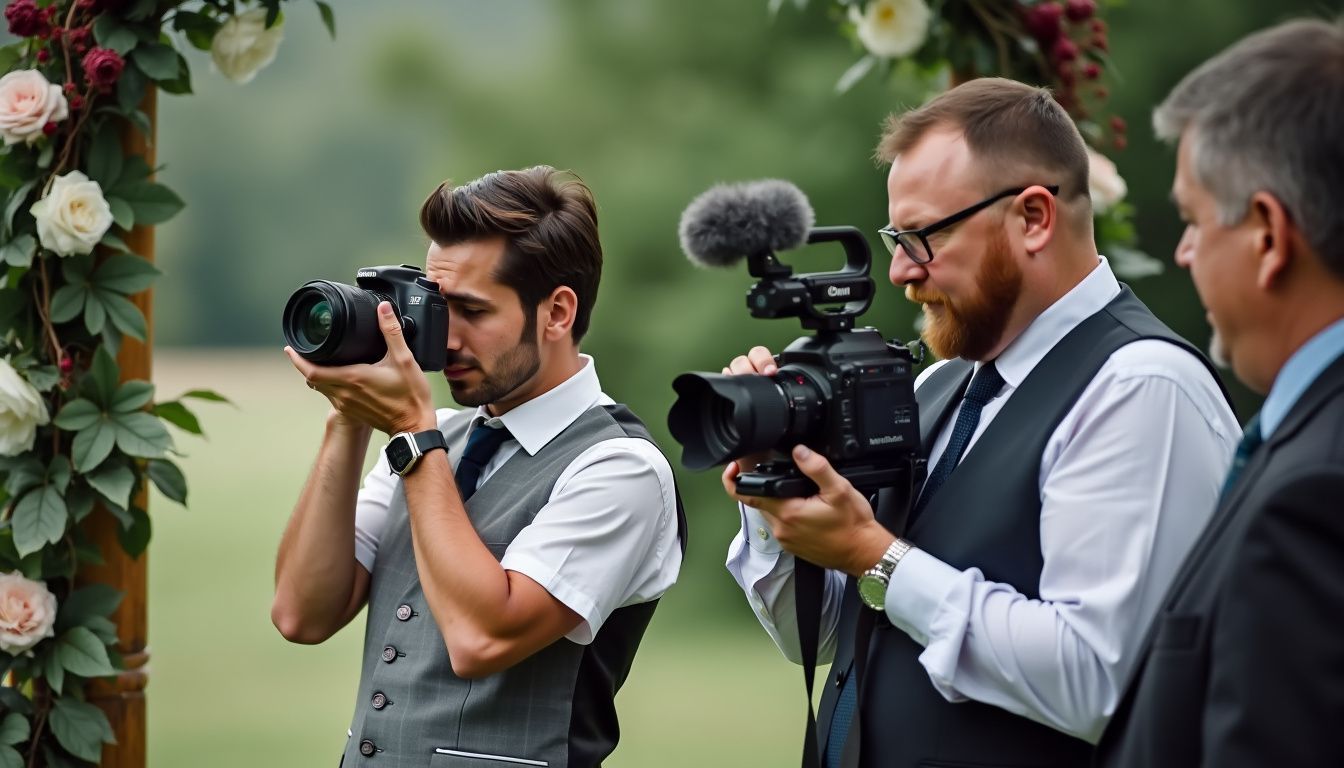
The convention experienced crews follow is simple enough to put in an email. The photographer leads portraits and family formals, since those are static setups they are directing. The video team works the edges, grabbing movement between shots. The video team also leads anything sound-dependent: vows, speeches, where the officiant stands, reception introductions. During the ceremony they split sides and stay put. Good crews settle flash discipline before the reception. Either bounce off ceilings, or accept that a few clips will carry a visible pulse.
Build a 15 minute buffer into the timeline before the ceremony and another before the first dance. Both vendors need it, and neither will ask for it in front of your planner. It is the cheapest fix on this entire page.
If aerial coverage is on the list, tell the photographer where the aerial drone crew plans to launch. Nobody wants a DJI Mavic 4 Pro parked on the lawn behind the golden hour portraits. Confirm the operator holds a current FAA Part 107 remote pilot certificate, since every paid flight requires one. Also check whether your venue sits inside controlled airspace that needs prior authorization.
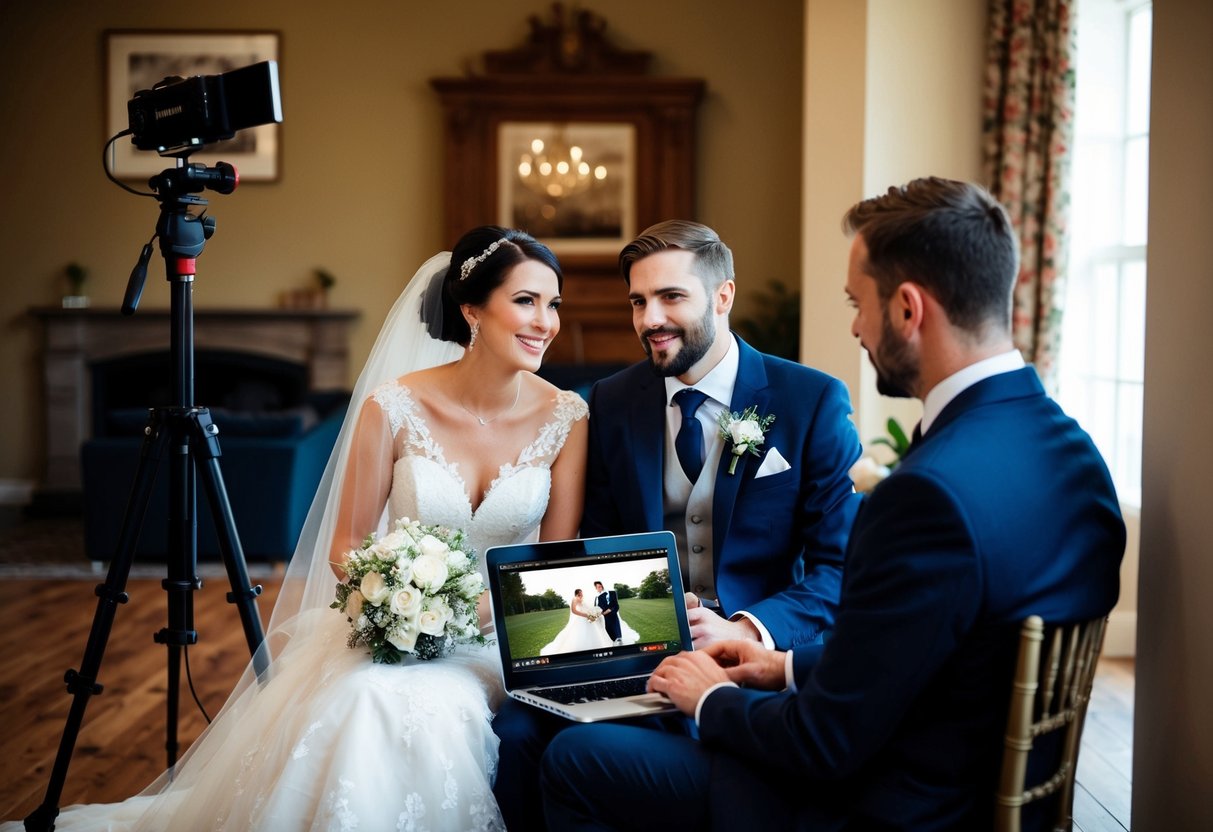
What to ask before you sign either contract
The questions that separate a solid vendor from a risky one are mostly the same on both sides. The exception is audio.
- How many audio sources do you record during the ceremony, and what happens if the primary lavalier fails?
- Who exactly is shooting my date, and what does the contract say if they cannot attend?
- When did you last deliver late, and what caused it?
- How are cards backed up on the day, and where does the footage live until delivery?
- What is the total price with travel, overtime, and the add-ons I have mentioned?
- Do you carry liability insurance, and can you send a certificate naming my venue?
That last one is not a formality. Plenty of venues will not let a vendor through the door without a $1M certificate on file. Finding that out during your wedding week is a bad way to spend your wedding week.
Ask both vendors for a full wedding, not a highlight reel. A four-minute film cut from the best eight seconds of every hour proves the editor is good. A full ceremony edit proves the camera operator can hold a steady frame. It also proves the audio is still clean at minute 22. Same principle on the photo side: ask for a complete gallery from one date, not a curated top thirty.
Then read the deliverables clause slowly. It should name the exact number of edited images, or the exact runtime of every video deliverable. It should give the delivery window in weeks and the revision count. Ask how long the studio archives your files. Vague language there is where cheap quotes hide expensive surprises later. More on standard contract terms sits in the vendor FAQ.
Book whichever vendor you care about most first, then build around them. The wedding photographer vs videographer tradeoff gets much simpler once your top choice is locked. Then you know exactly what money is left. In busy markets the good ones are gone 10 to 14 months out. This is not a decision that rewards waiting.