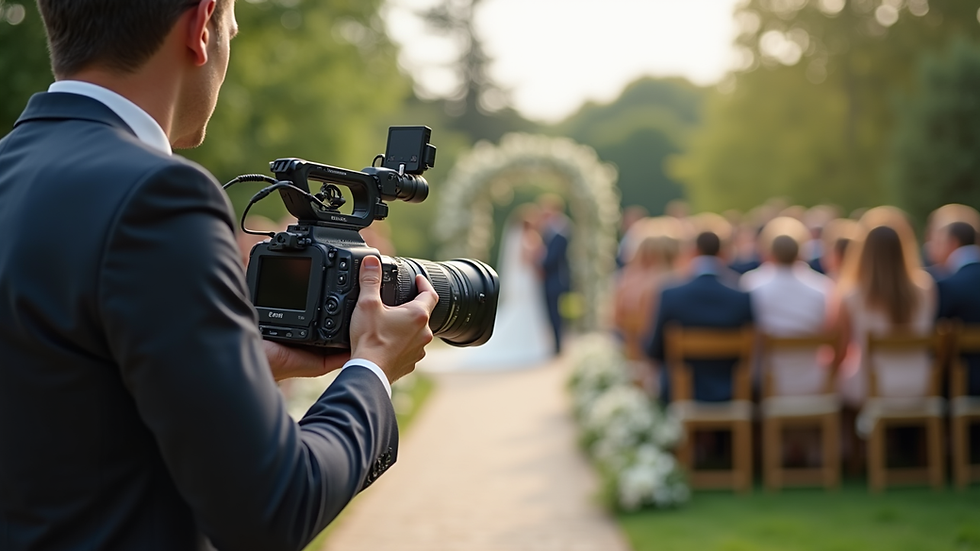
Your ceremony lasts twelve minutes. The vows you spent a month rewriting happen in about ninety seconds of that. Point a camera’s built-in microphone at them, and most of what you said gets buried. Wind, a passing car, an officiant who stands closer to the lens than you do: all of it wins. Wedding video audio is the part almost nobody asks about before booking. It is also the part that separates a film you rewatch every anniversary from one you quietly mute. Here is how the sound gets captured, why it beats another camera body, and what to ask before you sign.
Why audio matters more than a second camera
Couples spend hours comparing 4K against 6K, cinematic against documentary, one shooter against two. Almost none of them ask how the vows get recorded. That is backwards. You can watch a slightly soft image and still feel the moment. You cannot feel a thing from a vow track that sounds like a tin can across a parking lot.
The emotional core of a wedding film is spoken word. The vows. The officiant’s blessing. The best man landing a joke. A father’s voice cracking during the toast. Every one of those moments is audio first and picture second. A shooter can cut around a missed shot. Nobody can cut around a vow that was never cleanly recorded, because it happened once and cannot be reshot.
This is why experienced shooters treat sound as a parallel production running all day. They are not pointing a camera and hoping. They place three or four independent recorders. They check levels between the ceremony and cocktail hour. They carry spare batteries like a paranoid person, because they have all lost a track once and never wanted that feeling again. Most couples underrate this, and wedding video audio is the easiest place to overspend on cameras while starving the part you actually replay.

The gear behind clean wedding video audio
The workhorse of wedding video audio is the wireless lavalier. A small transmitter clips to the groom’s belt or rides in a jacket pocket. A tiny mic runs up under the shirt to the lapel. The two systems you see most on wedding days right now are the Rode Wireless GO II and the DJI Mic 2. Both run roughly $290 to $350. Both record a backup copy straight onto the transmitter. Higher-end shooters carry Sennheiser AVX or EW-DP kits at $600 to $1,000 per channel for better range and fewer dropouts in crowded RF.
The lav capsule matters as much as the transmitter. A stock clip-on sounds fine. A dedicated Rode Lavalier II or a Sennheiser MKE-2, at $80 to $300, sounds warmer and rejects more clothing rustle. Many videographers do not trust a wireless signal alone. They also run a small handheld recorder at the source, usually a Zoom H1essential or an H6. A $99 recorder taped to a podium or tucked behind the ceremony flowers is the cheapest insurance in the whole kit.
Outdoors, every one of those mics needs wind protection. A foam cap is not enough on an exposed lav. Shooters slip a furry cover, a Rode MiniFur or a Bubblebee Lav Concealer, over the capsule and often tape it to the chest with medical moleskin to kill fabric noise. Recorders capture at 24-bit, 48kHz to match the video timeline and leave headroom, so a sudden laugh does not clip.
On the camera itself, a shotgun mic like a Rode NTG or a Deity S-Mic grabs the room: the crowd reaction, the applause, the general ambience. That track is never the primary vow recording. It is the glue that makes the clean lav audio sit inside the space. Skip it and your vows sound like they were recorded in a closet.
How a videographer mics the ceremony
Walk into a well-run ceremony and you will find mics in three or four places you would never spot. The groom wears a lav. He stands still and faces the bride, so his mic also catches her vows from a couple of feet away. The officiant often wears a second lav, or stands near a planted recorder, since they read the vows line by line.
Hiding the transmitter takes practice. A Wireless GO II is small enough to sit in a breast pocket, but the cable still needs routing so it does not tug or rustle. Most shooters run the lav under the shirt and anchor it with a strip of gaffer tape. On a groom in a lightweight linen suit, even that can telegraph noise, so they test it during the first look and adjust before anyone walks the aisle.
The smart move is redundancy at the altar. Beyond the groom’s wireless, a lot of shooters plant a Zoom recorder inside the podium, behind a floral arrangement, or clipped to a front-row chair. If the venue has a house sound system, they will ask to run a line straight off the board. That feed carries whatever hits the venue speakers, usually a podium mic the officiant already holds.
The bride’s vows are the tricky part. Many brides cannot wear a transmitter, because the dress has no pocket and no belt. The groom’s lav becomes the primary source for her voice, backed by the planted recorder and the board feed. Good videographers land her ninety seconds on more than one track. If someone tells you they will point a shotgun from the aisle and call it done, keep looking. That answer alone tells you they treat wedding video audio as an afterthought.

Speeches, toasts, and reception sound
The reception is a different problem. Speeches almost always run through the DJ or band’s PA, and the cleanest source is a direct feed off that mixing board. A videographer plugs a recorder into a spare output and captures the toast exactly as the room hears it, with no crowd noise on top. This is why the good ones introduce themselves to the DJ early. That thirty-second chat during setup beats any single piece of gear.
The connection details matter more than they sound. A soundboard usually hands out a balanced XLR or a quarter-inch output, so the videographer needs the right adapter and a way to tame a hot signal before it hits a consumer recorder. Set the gain too high and the toast distorts. Set it too low and you fight hiss in the edit. A good shooter tests the feed during the DJ’s setup, not during the maid of honor’s second sentence.
Bands complicate the handoff. A live band’s engineer runs a busier board than a solo DJ. The spare output you want may already feed a monitor. The fix is a quick word during soundcheck. Add a backup lav on the vocal mic in case the feed dies mid-toast.
When a board feed is not available, the fallback is a wireless lav on the toast mic itself, or a recorder at the head table. First dances and any spoken moments over dinner get an ambient recorder running the whole time, so nothing off-mic is lost. Reception light is dim and the room is loud. Audio quietly does the heavy lifting while the cameras fight for a usable image.
One detail buyers rarely think about is music. The DJ’s tracks bleed into every reception recording, and licensed pop songs cannot legally be published in your film. That is a real constraint. It is worth reading up on how to license music for wedding videos legally before you assume your first-dance song makes the final cut. Your videographer will usually swap in a cleared track and keep the live audio for spoken moments only.
What goes wrong, and how backups save the film
Every working shooter has a horror story. A transmitter battery dies eight minutes into a twelve-minute ceremony. A cheap lav catches every brush of a boutonniere and turns the vows into a scratch. RF interference from the venue’s own wireless drops the signal the moment the bride starts to cry. Wind on an outdoor bluff roars over everything unless the mic wears a furry windscreen.
One failure hits vineyard and barn weddings often. Their older wireless mic systems share the same 2.4GHz band as a Rode kit, and the two step on each other the second they power up. A shooter who scouts the room swaps to a hardwired recorder at the altar before it becomes a problem. The couple never hears about the near miss, which is the whole point.
The answer to all of it is one word: redundancy. A vow recorded on a single device is a gamble. That same moment landing on a groom’s lav, a planted recorder, and a board feed turns one failure into an annoyance instead of a disaster. This redundancy is the biggest gap in wedding video audio between a hobbyist and a professional. It also costs the pro real money in duplicate gear they hope to never touch.
Batteries get swapped between the ceremony and the reception on a fixed schedule, not when they feel low. Every recorder captures a safety track at a lower level, in case someone shouts or laughs and clips the main channel. None of this shows up in a portfolio. All of it shows up the day something breaks. If a quote looks cheap, audio planning is usually the corner that got cut.

Questions to ask before you book
You do not need to become an audio engineer to hire well. You need a few pointed questions and a good ear for confident, specific answers. Vague reassurance is the warning sign. A pro will happily walk you through their setup, because they are proud of it.
- How many separate devices record the vows, and what happens if one fails?
- Do you take a direct feed off the DJ or band’s soundboard for speeches?
- Who wears a mic during the ceremony, and how is the bride’s voice captured?
- Can I hear raw vow audio from a recent wedding, not just the edited highlight?
That last one matters most. A highlight film mixes the vows under music, which hides a lot of sins. Ask for thirty seconds of clean, unedited ceremony sound. If it lands in your inbox without hesitation, their audio game is real. For more on telling a strong shooter from a weak one, the general guidance on questions to ask before booking a wedding videographer applies here too.
One more test costs you nothing. Ask what their wedding video audio backup looks like on a rainy indoor ceremony versus a windy beach. A shooter who has worked both will answer in seconds, naming specific windscreens and indoor mic placements. A vague answer here is the tell that they own one kit and hope for calm weather.
Does better audio cost more?
Usually, yes, and the reason is honest. Redundant sound means a shooter buys and maintains several wireless systems, multiple field recorders, spare capsules, and a case of batteries. Then they spend editing hours syncing and cleaning every track. A videographer running one $150 wireless kit can charge less. One running three sources and a board feed has more invested and more labor in post. Good wedding video audio is a real line item, not a rounding error.
The gap is smaller than you might fear. Wedding video audio redundancy is not what makes a film expensive. A second shooter, a same-day edit, or extended coverage moves the price far more. You are more likely to find a $3,200 package with excellent sound and a $2,800 package with mediocre sound than a clean $1,000 gap tied to audio alone. If you want to see what drives the total, the breakdown of how wedding videographer packages are priced beats assuming audio is the line to cut.
What you should refuse is a cheap package that quietly skips audio planning. Ask the questions above and match the answers to your budget. Strong wedding video audio is rarely the priciest part of the day. It is almost always the part you would pay anything to get back once it is gone.
Before you sign, send your top two videographers the same message: ask for thirty seconds of raw vow audio from a real wedding. The one who replies fastest with the cleanest track is the one who takes sound as seriously as you take the day.