
Your second camera died forty minutes into a reception last summer, and you finished the first dance on a single body praying the card would hold. That is usually the moment someone decides to get serious about their wedding videography gear. A wedding is a live event with no reshoots, no second take on the first kiss, and no polite way to ask the bride to walk back down the aisle because your audio dropped out.
This is a working breakdown of what actually goes in the bag, what each piece costs in 2026, and where a beginner should spend versus save. It is written for videographers building toward paid work, not for someone assembling a dream list they will never afford. The gear that matters at a wedding is rarely the flashy stuff. It is redundancy, clean audio, and enough battery to outlast a ten-hour day.
Why you need two camera bodies, minimum
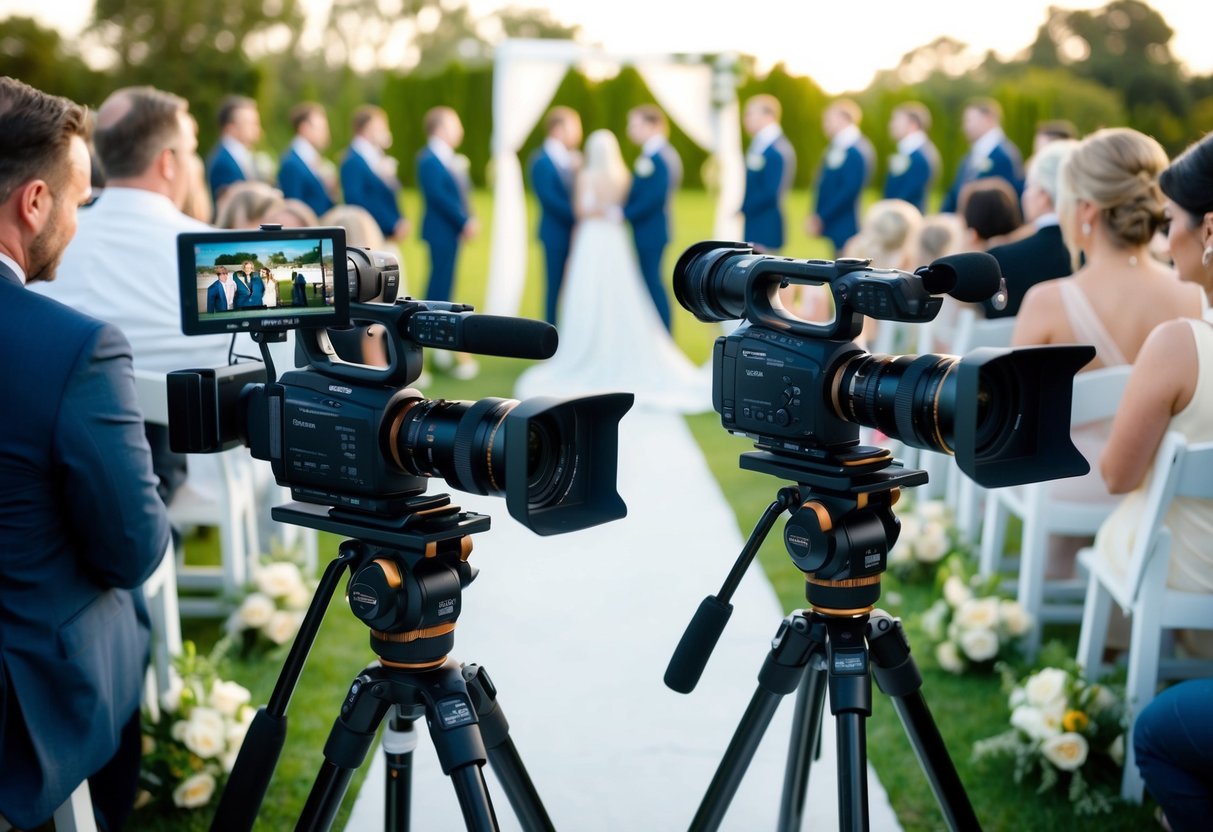
One camera is a hobby. Two cameras is a business. The reason is not just coverage, though shooting a ceremony from two angles is close to mandatory. The real reason is that hardware fails, and when it fails at a wedding you cannot reshoot the vows. A second body means a dead camera is an inconvenience, not a lawsuit.
Most working shooters in 2026 build around Sony, Canon, or Panasonic. On the Sony side, the FX3 (around $3,900 body only) is the reception-and-low-light workhorse because it handles dim churches and candlelit dinners without turning into mush. Pair it with an A7 IV (about $2,500) or a second A7S III (roughly $3,500) and you have matched color science across both angles, which saves hours in the grade. Canon shooters lean on the R6 Mark II (near $2,500) and the R5 (about $3,900) for the same reasons. Panasonic’s S5 II (around $2,000) undercuts both and finally fixed the autofocus complaint that kept it off wedding sets for years.
You do not need two flagship bodies to start. A common beginner setup is one strong low-light body plus a used older model as the backup and second angle. A used A7 III still runs around $1,000 to $1,300 and will hold a locked-off ceremony shot perfectly well. What matters is that both cameras record to the same codec and roughly match in color, so your two angles cut together cleanly.
The lenses that actually earn their keep
You can shoot an entire wedding on three lenses, and most people who own eight only ever reach for three. A fast standard zoom covers the majority of the day. The Sony 24-70mm f/2.8 GM II (about $2,300) or the more affordable Tamron 28-75mm f/2.8 (around $700 used) lives on your main body from prep through reception. It is the lens you grab when you have no time to think.
After that, a bright prime changes the look. A 35mm f/1.4 or an 85mm f/1.8 gives you the shallow, cinematic separation clients associate with expensive work, and the 85mm in particular flatters people during portraits and speeches. The Sony 85mm f/1.8 is a bargain at roughly $600 and outperforms its price on skin tones. For the ceremony, where you often cannot move, a 70-200mm f/2.8 (about $1,800 to $2,600 depending on brand) lets you pull tight on the couple’s faces from the back of a church without becoming the videographer everyone remembers for the wrong reasons.
A quick word on tradeoffs. Fast primes are sharper and better in low light, but swapping lenses mid-ceremony is how you miss the ring exchange. That is another argument for two bodies: put the zoom on one, the prime on the other, and stop changing glass while something important is happening.
Audio is where amateurs get exposed
Clients forgive a slightly soft shot. They do not forgive not being able to hear their own vows. Audio is the single most common place where cheap wedding videography gear falls apart, and it is also the cheapest problem to fix well.
Run at least two independent audio sources during the ceremony. A lavalier on the officiant or groom captures the vows up close: a Tascam DR-10L (around $180) or a Sennheiser lav into a small recorder is the reliable standard, and many shooters now use the DJI Mic 2 wireless kit (about $350) for its onboard recording backup and clean range. Then plant a recorder near the sound source, whether that is the venue’s PA feed or a Zoom H5 (roughly $280) placed by a speaker. If you can get a line out from the DJ or the ceremony PA, take it, because a board feed beats any microphone in the room.
The principle is redundancy again. If the lav battery dies, the room recorder saves you. If someone kicks the room recorder, the lav saves you. Nothing here is expensive. A full three-source audio kit runs under $900 and is the highest-return money a beginner can spend, more valuable than a second lens or a nicer gimbal.

Stabilization: gimbal, monopod, or steady hands
Every beginner thinks they need a gimbal for everything. Then they carry a DJI RS 4 (around $550) through an eight-hour day and learn that a monopod and good handheld technique cover eighty percent of the work with a fraction of the fatigue. The gimbal is a tool for specific shots, not a default mode.
Use the gimbal for movement that has to be smooth and deliberate: walking the couple through a reveal, following them down a hallway, orbiting during portraits. For everything else, in-body stabilization on modern bodies plus a monopod gets you clean, controlled footage without the setup time. A sturdy monopod (about $120 to $200) with a fluid head is genuinely one of the most underrated pieces in the bag, especially during a ceremony where you want a locked but repositionable frame.
If you shoot a lot of dance floors and want that gliding, energetic look, the gimbal earns its keep. Just budget the time. Balancing a rig, swapping to it mid-event, and switching lenses on a balanced gimbal all cost minutes you may not have. Many experienced shooters keep the gimbal pre-balanced on a second body specifically so they never have to rebalance during the day.
Lighting for dark churches and reception halls
Receptions are dark, uplit in colors that wreck skin tones, and constantly changing. You cannot fix that in post as well as you can fix it with one small light. A couple of portable LEDs turn muddy, noisy footage into something clean.
An on-camera light like the Aputure MC (around $90 each, often bought in a set of two or four) is small enough to live in a pocket and bright enough to fill a face during the getting-ready hour. For the reception, an Amaran or Godox panel on a light stand (roughly $150 to $300) bounced off a ceiling gives you a soft key that follows the couple through first dances and toasts. The trick is to add just enough light to hold shadow detail, not to blast the room and announce that a video crew has taken over.
Match your light temperature to the room. A reception lit in deep purple uplighting will fight a daylight-balanced panel, so being able to dial color temperature and tint on the fly matters more than raw output. Battery-powered LEDs also keep you mobile, which is the whole point at an event where you are never in one spot for long. Two small lights and a couple of stands, under $500 total, cover most weddings.
Cards, batteries, and the boring gear that saves the day
The gear that ends careers is never the camera. It is the memory card that corrupts, the battery that dies during the toast, the missing card reader at 1 a.m. when you are trying to back up before bed. This is the unglamorous part of a wedding videography kit, and it is non-negotiable.
Carry more cards than you think you need, and buy from names you trust: SanDisk, Sony, Angelbird, ProGrade. CFexpress Type A cards for the FX3 line are painfully expensive (a 160GB card runs around $250 to $350), which is another reason the cheaper SD-based bodies stay popular. Format cards fresh before every wedding, and never delete footage from a card until it exists in two places.
A short checklist of what should always be in the bag:
- Enough batteries for a full day, meaning six to eight per body, plus a dual charger you can run during dinner.
- Two card readers, because one will fail eventually and you back up on the same night you shoot.
- A portable SSD or two for on-site backup, so footage lives in two locations before you leave the venue.
- ND filters (variable or a set) to keep your shutter correct in bright outdoor ceremonies.
Backup workflow is part of your gear, not an afterthought. Offload every card to two drives the night of the wedding. Clients who want the original files are a separate conversation worth reading up on, and you can point them to a guide like whether to ask for raw footage rather than improvising a policy on the spot.
What a complete wedding videography gear kit costs
A complete professional wedding videography gear kit, bought new, lands somewhere between $8,000 and $15,000 once you add two capable bodies, three lenses, a proper audio setup, stabilization, lighting, and enough cards and batteries to survive a real day. That number scares beginners, and it should not, because almost nobody buys it all at once.
Here is a sane order of priority. Get one strong low-light body and one fast standard zoom first, because those shoot the whole day. Add the audio kit next, since clean sound separates you from every amateur with a nice camera. Then a second body for redundancy, then a prime lens for the cinematic look, then lighting, then the gimbal last. Buying used through KEH or MPB knocks thirty to fifty percent off and is how most working shooters actually built their kits. A serviceable starting setup running around $3,500 to $5,000 can absolutely book paid weddings if the person behind it knows how to use it.
Gear does not book clients, though. Your reel and your reliability do. If you have the kit and want the jobs, the faster path is getting your work in front of couples who are actively hiring, whether through a directory of wedding videographers or by understanding how BookVideographer connects shooters with clients. You can see where you fit on videographer pricing and join as a videographer once your kit and your first few films are ready to show.
Before your next booking, do one thing: run a full mock ceremony in your living room with both cameras, both audio sources, and a fresh backup afterward. The wedding day is the worst possible time to discover your wedding videography gear has a gap in it.